Showing posts with label michael dirrs. Show all posts

Monday, April 20, 2009

Old Hat or All That?

On this plant list in particular and also throughout the semester there have been a few plants labeled something like, "Plants You May Find In Your Grandma's Yard" or as Michael Dirr may say "The Over The Hill Gang". These are the plants that used to be really popular but were eventually replaced with newer, more trendy plants. As a landscape designer, horticulturalist, or someone in production, hearing this information in class may have deterred you from ever using these "stale" old plants in any area. After all, this seems to be a strategy many professionals seem to be taking since really, these plants don't appear in modern landscapes hardly at all.

As someone kind of partial to these old favorites, here's a few exciting varieties worth taking a second look at:

Syringa vulgaris or Common Lilac: The straight species of this in renouned for its intensely fragrant flowers, and great lilac spring color. But, it is also scraggly, prone to mildews and diseases, and confusing when it comes to pruning. Cultivars such as 'Little Boy Blue' (blue) and 'Prarie Petite' (pink) have a more compact habit which makes it more versatile in the landscape. 'Prince Wokonsky' has double flowers, and 'Elsa Maasik' (deep purple) is more disease resistant than the straight species. 'Albert F. Holden' is bicolor.


Chaenomeles speciosa or Common Floweringquince: This may be dismissed as too scraggly or wild, but the flower show is what really makes planting a Floweringquince worth it. Going from there, lots of different flowering varieties have been released covering the gamete between white and dark red. 'Jet Trail' (white), 'Minerva' (red), and 'Texas Scarlet' (red) are a few of the more compact varieties if the Floweringquince's legginess is too much for you. 'Scarff's Red' is a thornless variety available, although the thorns may come in handy for a barrier or hedge.


Spirea prunifolia or Bridalwreath Spirea: ... Ok that one may not have any hot new varities, but take a look at it at this time of year. Its one of the greatest for full white spring flowering, and attracts tons of wildlife including honeybees and ladybugs (both of which are necessities for any healthy garden). And the rest of the year, it makes a nice green mounded background for your summer and fall flowering colors.


Sources:

Dirr, Michael A. Manual of Woody Landscape Plants. 215-216, 962-963, 986-991
Common Lilac picture 'Albert F. Holden' from http://www.naturehills.com/images/productImages/SyrvulgAlbertFHoldenLilacviolet_big.jpg
Floweringquince picture 'Texas Scarlet' from http://www.jparkers.co.uk/images/new_products/ST0403.JPG
Bridalwreath Spirea picture from http://www.donnan.com/images/SpireaBridalWreath.jpg

Friday, January 23, 2009

Cedrus atlantica 'Aurea' - Golden Atlas Cedar

One thing that you may come to find from taking plant identification classes, is that cultivars that have different habits, heights, and colors are usually more valued horticulturally. The specimen of Cedrus atlantica 'Glauca' the class saw in front of the Ellington Plant Sciences building is valued compared to other coniferous options because of its blue color and the horizontal habit it gains with age. Dirr, the writer of the text Manual of Woody Landscape Plants, points out that C. 'Glauca' could even be taken as the true variety of Atlas Cedar, and that the blue color occurs naturally (like with Colorado Blue Spruces). The needles are held in spherical bundles, generally of 15 needles per bundle. Dirr says of this Atlas Cedar that it is an, "extremely picturesque and interesting tree, its beauty perhaps unmatched by any other confier."

Cedrus atlantica 'Aurea' is a cool Atlas Cedar because in addition to its foliages' striking blue color, there is a shock of yellow at the tips of the branches. When planting golden varieties of confiers, its usually a good idea to plant them where they can get full morning sun and partial sun in the afternoon. This should prevent foliage damage by the sun. The golden variegation should be more noticible in the Spring when it has more new growth. In the UT Gardens, yellow spring-flowering plants such as daffodils are nearby to accentuate the Gold Atlas Cedars golden foliage.


Source: Dirr, Michael A. Manual of Woody Landscape Plants. 196-197.

Thursday, October 30, 2008

Cercidiphyllum 'Pendula'

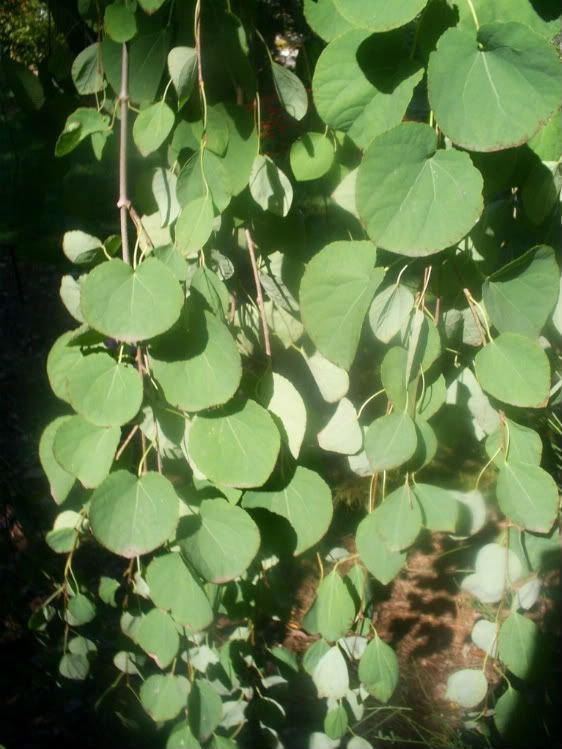
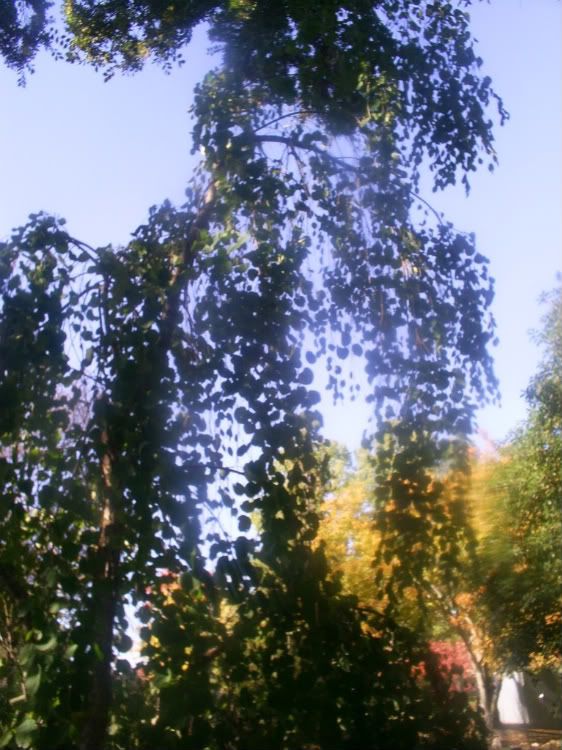
Walking through the lower rooms of the University of Tennessee Gardens, there is a unique tree that never fails to grab my attention. Its blue-green leaves with silver backs fluttering softly in the breeze bring to mind memories of a waterfall or fountain. Cercidiphyllum japonicum 'Pendula', commonly known as the Weeping Katsura Tree, is an excellent specimen plant, especially for areas designed for calm and reflection. You would be hard-pressed not to feel more relaxed in the presence of its cool foliage color, graceful weeping habit, and gentle movement in the wind. It is pleasing to almost all the senses, especially since its leaves occasionally give off a fragrance likened to a cotton candy smell. Although this tree is deciduous, its light, shaggy bark and delicately hanging branches will still grab passerby attention in the winter months.

Michael Dirr in his Manual of Woody Landscape Plants mentions that this variety may grow 15 to 25 feet in height, but the specimen in the UT Gardens strikes me as being more around 30 feet tall. There is a similar variety called Cercidiphyllum magnificum 'Pendulum' (easy to confuse with 'Pendula') which could reach 50 feet in height. That variety has larger leaves, but according to Dirr may not weep as well as 'Pendula'.

'Pendula' would serve as a great specimen plant in the landscape for reasons already mentioned, and also because it is a fast grower that will fill in an area at the rate of one foot in height per year. One negative aspect to this plant is it would be a hassle to propagate one for yourself, unless you have the skill and tools to graft the weeping form onto a rootstock of the straight species.

In conclusion, this is a great plant any time of year, and would go great in an area of calm and reflection, a sensory garden, or especially near water.


silvery, blue-green foliage

habit makes me think of a hunch-back


Sources:

Dirr, Michael A. Manual of Woody Landscape Plants. 207-208.