There are several different myths on the origin of the Narcissus flower, but probably the most well-known is the Roman version told by the poet Ovid. According to the legend, there was an exceptionally handsome young man named Narcissus -- a man so handsome that every girl who saw him fell in love with him. But for some reason or another, Narcissus wasn't interested in women and denied all their romantic advances. After one particular incident where Narcissus broke a young woman by the name of Echo's heart -- the heartbreak of which reduced her to only a voice -- Narcissus came upon a pool of water. When he bent down to take a drink, Narcissus was struck by the beauty of the man looking up at him. And so he spent the rest of his days sitting by the pool of water, staring at his own reflection until he was no more. But from the spot where he sat by the water sprang a flower -- the Narcissus we're learning in class.
In the legend and today, the love of Narcissus is something experienced by many. As it goes with just about any plant or flower, there are several groups dedicated to developing new varieties, informing the public about the care of Narcissus plants, and more than anything, just coming together to experience the beauty of this beautiful plant! Last year, I had the opportunity to attend the East Tennessee Daffodil Society Show and see the huge variety of plants growers had tenderly cared for and selected in the hopes that their Daffodil would be recognized at the show.
Daffodils are judged by their category, and over the years 13 categories to classify each type have emerged, and miniature varieties of most divisions. Below are photographs of an example of each category from the American Daffodil Society website - www.daffodilusa.org
1. The Trumpet Division: When I remember this, I picture someone playing a trumpet. These daffodils' cups are at least as long if not longer than the length of the petals. Also, like many of the daffodil's we're familiar with, it has only one flower per stem.
2. The Large Cup Division: These cups are still large, but smaller than those of the Trumpet division -- between 1/3 the length of a petal and the length of a petal. These also have only one flower per stem.
3. The Small-Cup Division: This cup is smaller than the Large Cup division; that is, the cup measures 1/3 the length of a petal or less. Again, there is only one bloom per stem.
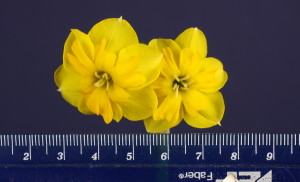
4. The Double Petal Division: Instead of having just one set of petals, there are two, lending a more ruffled appearance. There can be more than one flower per stem on this type.

5. Triandrus Division: Take a look at the picture below, and your first thought may be that these flowers look kind of like hanging bells. According to the American Daffodil Society, this type usually has at least two if now more flowers per stem.

6. The Cyclamineus Division: Looks like a person with long hair being blown back by the wind. One flower per stem.

7. The Jonquilla Division: These are the Jonquills we hear so much about living in East Tennessee. Some of the older generation are so familiar with Jonquills that they are prone to label all Narcissus as Jonquill, but really Jonquills are only those in this category. The Jonquill flowers are really fragrant, with flat petals and narrow foliage. Can have as many as three blooms on a stem.

8. The Tazetta Division: These fragrant flowers clusters generally come with more than three on a stem. This profusion may be the reason why the stems are so thick -- the plant needs to transfer more up and down the stem than if there were only a few flowers.

9. The Poeticus Division: White petals with a crinkley disk. The disk color generally follows the same color scheme: green, yellow, red rim. Also fragrant with just one flower per stem.

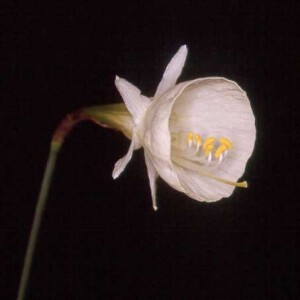
10. The Bulbocodium Division: This is a weird hybrid division, where the flowers look like a woman wearing a hoop petticoat that fell over.

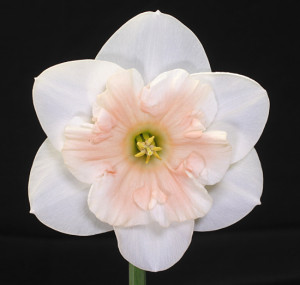
11. The Split-Cup Division: Instead of having a tea-cup, petticoat, or trumpet shaped cup, these flowers' cups have split to fall with the back petals usually at more than half the length of the back petal.

12. Miscellaneous Division: These flowers don't fit into the previous 11 divisions, probably because they're a hybrid between two or more different divisions.

13. The Wild Division: Narcissus as you might find them in nature.

14. The Miniature Division: Blooms tend to be less than 1.5 inches in diameter.

Narcissus are great to use in the landscape as specimens (for a little while at least, as they divide relatively quickly), mass clumpings, or even as an alternative lawn! And if you're interested, you can find daffodils that flower in early spring, or early summer. In my home landscape, you'll see daffodils from late February until early June. But keep in mind that these bulbous plants don't like to be planted in poorly-drained soil. I'd recommend planting at the top of a slope or hill, or maybe a container. Another thing to remember is that even after the flower is gone, you should leave the foliage so the plant can store up energy for next year's flowers. As this isn't very attractive, try inter-planting with a summer-flowering plant like daylilies that can mask their foliage. Like most plants, daffodils like to be fertilized, you just have to do it at the right time. If you fertilize in spring or summer, you risk burning their delicate roots. The best time to fertilize is definitely fall, because it won't damage the roots and it will boost your flower performance the next spring!
To learn more about the genus Narcissus, you should go experience some first-hand. If you take a look at the UT Gardens this spring, you will surely be able to find several of these types of daffodils. Another great way to learn more is to check out the East Tennessee Daffodil Society Show that will be in the Hollingsworth Auditorium in the Ellington Plant Sciences Building this March 15-16. Its really interesting and there are plenty of informative people to talk to about these beautiful flowers!
In the legend and today, the love of Narcissus is something experienced by many. As it goes with just about any plant or flower, there are several groups dedicated to developing new varieties, informing the public about the care of Narcissus plants, and more than anything, just coming together to experience the beauty of this beautiful plant! Last year, I had the opportunity to attend the East Tennessee Daffodil Society Show and see the huge variety of plants growers had tenderly cared for and selected in the hopes that their Daffodil would be recognized at the show.
Daffodils are judged by their category, and over the years 13 categories to classify each type have emerged, and miniature varieties of most divisions. Below are photographs of an example of each category from the American Daffodil Society website - www.daffodilusa.org
1. The Trumpet Division: When I remember this, I picture someone playing a trumpet. These daffodils' cups are at least as long if not longer than the length of the petals. Also, like many of the daffodil's we're familiar with, it has only one flower per stem.
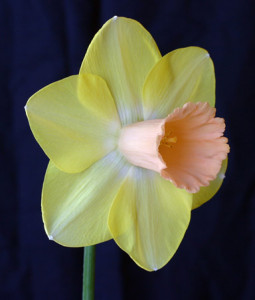 |
| the trumpet division |
2. The Large Cup Division: These cups are still large, but smaller than those of the Trumpet division -- between 1/3 the length of a petal and the length of a petal. These also have only one flower per stem.
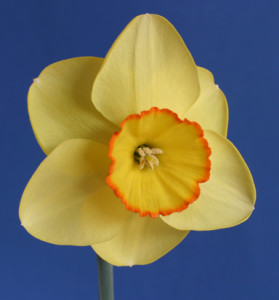 |
| the large cup division |
3. The Small-Cup Division: This cup is smaller than the Large Cup division; that is, the cup measures 1/3 the length of a petal or less. Again, there is only one bloom per stem.
 |
| the small-cup division |
4. The Double Petal Division: Instead of having just one set of petals, there are two, lending a more ruffled appearance. There can be more than one flower per stem on this type.
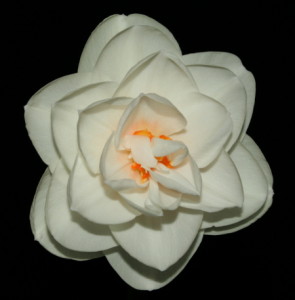
5. Triandrus Division: Take a look at the picture below, and your first thought may be that these flowers look kind of like hanging bells. According to the American Daffodil Society, this type usually has at least two if now more flowers per stem.
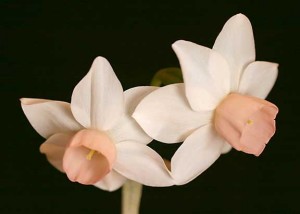
6. The Cyclamineus Division: Looks like a person with long hair being blown back by the wind. One flower per stem.
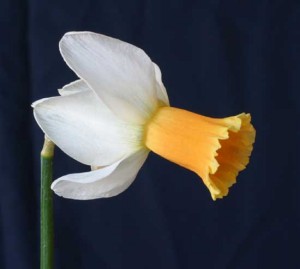
7. The Jonquilla Division: These are the Jonquills we hear so much about living in East Tennessee. Some of the older generation are so familiar with Jonquills that they are prone to label all Narcissus as Jonquill, but really Jonquills are only those in this category. The Jonquill flowers are really fragrant, with flat petals and narrow foliage. Can have as many as three blooms on a stem.

8. The Tazetta Division: These fragrant flowers clusters generally come with more than three on a stem. This profusion may be the reason why the stems are so thick -- the plant needs to transfer more up and down the stem than if there were only a few flowers.

9. The Poeticus Division: White petals with a crinkley disk. The disk color generally follows the same color scheme: green, yellow, red rim. Also fragrant with just one flower per stem.
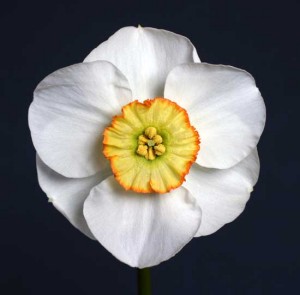
10. The Bulbocodium Division: This is a weird hybrid division, where the flowers look like a woman wearing a hoop petticoat that fell over.
11. The Split-Cup Division: Instead of having a tea-cup, petticoat, or trumpet shaped cup, these flowers' cups have split to fall with the back petals usually at more than half the length of the back petal.
12. Miscellaneous Division: These flowers don't fit into the previous 11 divisions, probably because they're a hybrid between two or more different divisions.

13. The Wild Division: Narcissus as you might find them in nature.
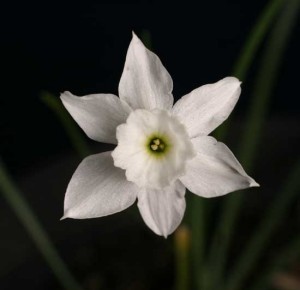
14. The Miniature Division: Blooms tend to be less than 1.5 inches in diameter.
Narcissus are great to use in the landscape as specimens (for a little while at least, as they divide relatively quickly), mass clumpings, or even as an alternative lawn! And if you're interested, you can find daffodils that flower in early spring, or early summer. In my home landscape, you'll see daffodils from late February until early June. But keep in mind that these bulbous plants don't like to be planted in poorly-drained soil. I'd recommend planting at the top of a slope or hill, or maybe a container. Another thing to remember is that even after the flower is gone, you should leave the foliage so the plant can store up energy for next year's flowers. As this isn't very attractive, try inter-planting with a summer-flowering plant like daylilies that can mask their foliage. Like most plants, daffodils like to be fertilized, you just have to do it at the right time. If you fertilize in spring or summer, you risk burning their delicate roots. The best time to fertilize is definitely fall, because it won't damage the roots and it will boost your flower performance the next spring!
To learn more about the genus Narcissus, you should go experience some first-hand. If you take a look at the UT Gardens this spring, you will surely be able to find several of these types of daffodils. Another great way to learn more is to check out the East Tennessee Daffodil Society Show that will be in the Hollingsworth Auditorium in the Ellington Plant Sciences Building this March 15-16. Its really interesting and there are plenty of informative people to talk to about these beautiful flowers!