Showing posts with label red. Show all posts

Monday, August 11, 2014

Mixed Feelings for Eucalyptus dalrympleana

I try to start these blog posts with some kind of catchy reason why you should love the plant being profiled.  When it comes to Eucalyptus dalrympleana (USDA hardiness zones 8 to 11), there are just too many reasons to pick just one.  So instead of my normal format, this whole post will support the following reasons to love (or hate) this beautiful Euc.


E. dalrympleana has showy, vanilla
scented blooms that can be messy
Reason #1, Love: Its flowers smell like vanilla / Hate: The flowers also make a huge mess

In its native range of southwest Australia, Eucalyptus dalrympleana blooms through late summer.  At Kew, our specimens burst into flower in early August, and the blossoms linger through to September.  This species of Eucalyptus usually has clusters of three flowers, but some specimens from the northern tableland may have clusters of as many as seven flowers.

Although the very frilly blooms fall to bits and make a giant mess below the tree, I think that's a flaw worth forgiving.  The burden of sweeping the pathways at least one day a week is lightened if you can pause to enjoy being enveloped in their soft vanilla scent.


Reason #2, Love: Its leaves smell like cinnamon / Hate: It is constantly shedding leaves

Although many of the most familiar species of Eucalyptus have a soft blue cast to their leaves, E. dalrympleana has shining green foliage.  The attractive green foliage makes this plant a bit easier to place in the landscape than the more striking, blue-leaved Eucs.  When crushed, the leaves smell strongly of cinnamon.

Fruit and foliage of E. dalrympleana
The mountain gum near Kew's aquatic garden has been dropping leaves the whole time that I've been here.  Daisy and I usually have to rake them up at least once a week.  Some weeks Jim the volunteer has to rake them up too.  It's frustrating to think of the other things we could be doing with our time if this tree would just take a break.  However, this tree is easy to forgive because raking doesn't always take too terribly long, and when you step on or rake up the brown, dead leaves everything smells like cinnamon.


Reason #3, Love: In August, it makes the whole area smell like pumpkin pie / Hate: In August, you may have some "hay fever"

I know that so many other foods besides pumpkin pie contain both vanilla and cinnamon, but for some reason this tree just smells like pumpkin pie.  The week that the flowers really started to come in, Jim, Daisy and I were working around the trees at the aquatic garden.  Jim casually asked if I'd ever had pumpkin pie.  "Of course I have," I replied, "We have it every Thanksgiving."

This Eucalyptus is especially floriferous in August
He went on to casually mention that the last intern from the U.S. brought in a homemade pumpkin pie, and that he'd really enjoyed it.  At first I thought he was fishing for some pie (he may well have been), but when time passed and I couldn't shake a hankering for pumpkin pie, I realized that the tree was responsible for his comments.  Probably 100 feet all around these trees smelled strongly of the dessert.  Who could help but reminisce about pie when the spot you've been working for the past few hours smells so delicious?

Although I do love the smell of sweet pumpkin pie while I work, this plant has also been giving me some irritating allergies (or as they say in the U.K., "hay fever").  The overload of pollen has been giving me itchy, runny eyes, the sniffles, and some sinus pressure.  It hasn't stopped me from going out of my way to walk through the flowers on my way to the lockers yet though.

Really beautiful, but constantly
shedding, bark

Reason #4, Love: Its peeling, snow white and cinnamon bark / Hate: It is constantly shedding bark

Although the flowers and scent are nice, what really draws visitors up to these trees is the incredibly attractive bark.  Most of the surface is clean and white, but as is true with many Eucs, the bark peels.  This species will loose huge swathes of cinnamon red bark.  The bark looks really attractive while it's still on the tree.  Yet the bark is a bit irritating when it's scattered all below the tree.  We're constantly picking up chunks of bark from the lawn, paths, and raking it out of the beds below.


Reason #5, Love: Its sinuous, twisting wood and open habit / Hate: Fear of dropping limbs

E. dalrympleana has strong, heavy branches that are held nearly horizontally from the trunk.  This feature gives the trees a very open, savanna-like feel.  It also can be quite dangerous.

View from the inside of this mountain gum
One windy day, while I was intently trying to snap a clear shot of the flowers for this post, a visitor ambled up beside me.  "We call this tree the widdah-makah," said a young man with a thick Australian accent.  I didn't quite understand what he was saying at first, but I guess they call this tree the "widow maker" where he's from.  He explained that although the habit is beautiful, it's also a deadly combination.  Extremely heavy wood held at such an angle is prone to drop without much warning.  A heavy limb from up to 120 feet overhead can kill a person.  Thus the nickname.  "Men would go into the bush, but they wouldn't come back."

Kew's arborists keep an eye on this specimen, along with all the other trees on the property.  If you look up into the canopy, you can see the measures they have taken to prevent any falling limbs.  They remove any branches that they decide are dangerous, and they even tie supports to hold up the limbs that they suspect may fall.  Homeowners should avoid planting these trees in heavily populated areas and consult with an arborist for regular maintenance.


Reason #6, Love: Its sap looks like red spaghetti / Hate: Its sap will stain any pavement below the tree

Although the wound has nearly healed, you can
spot the red strands of sap eeking out of the cut
If you prune any tree, the wound will drip with sap until it begins to heal.  In my experience, the cut usually looks a bit damp for a bit, then dries up.  The sap of E. dalrympleana doesn't behave like any other sap I've seen before.  When it eeks from a wound, it comes out in thick, long, spaghetti-like strips.  The sap is a brilliant red, which makes the wounds quite showy.

Although this looks really very interesting, the sap does fall eventually.  If it falls on a pathway below, the sap can stain the pathway with red, sticky dots.


This tree is beautiful, adaptable, easy to love for all of its virtuous and even easier to forgive for all of its failings.  That is why this attractive Eucalyptus would make a valuable addition to any large garden or landscape.

If you have any questions, comments or suggestions, please feel welcome to leave a comment or send me an email.

To see more photos from this week, be sure to check out the album "Mixed feelings for this Eucalyptus" on the Plante on Plants Facebook page.  "Likes", shares and comments are appreciated.


All photos and videos were taken by Amanda Plante at the Royal Botanic Gardens, Kew unless otherwise stated in the caption.

Sources:
  • Center for the International Trade in Endangered Species database
  • Kelly, S.; Chippendale, G.M.; Johnson, R.D.  (1969).  Eucalypts.  Melbourne: Thomas Nelson (Australia) Ltd., page 38
  • Kew's Living Collections database
  • The International Union for Conservation of Nature and Natural Resources Red List of threatened species
  • The Plant List website
  • The Royal Botanic Gardens, Kew website and staff

Saturday, March 15, 2014

Looking for Spring Color? Go for a Native Maple

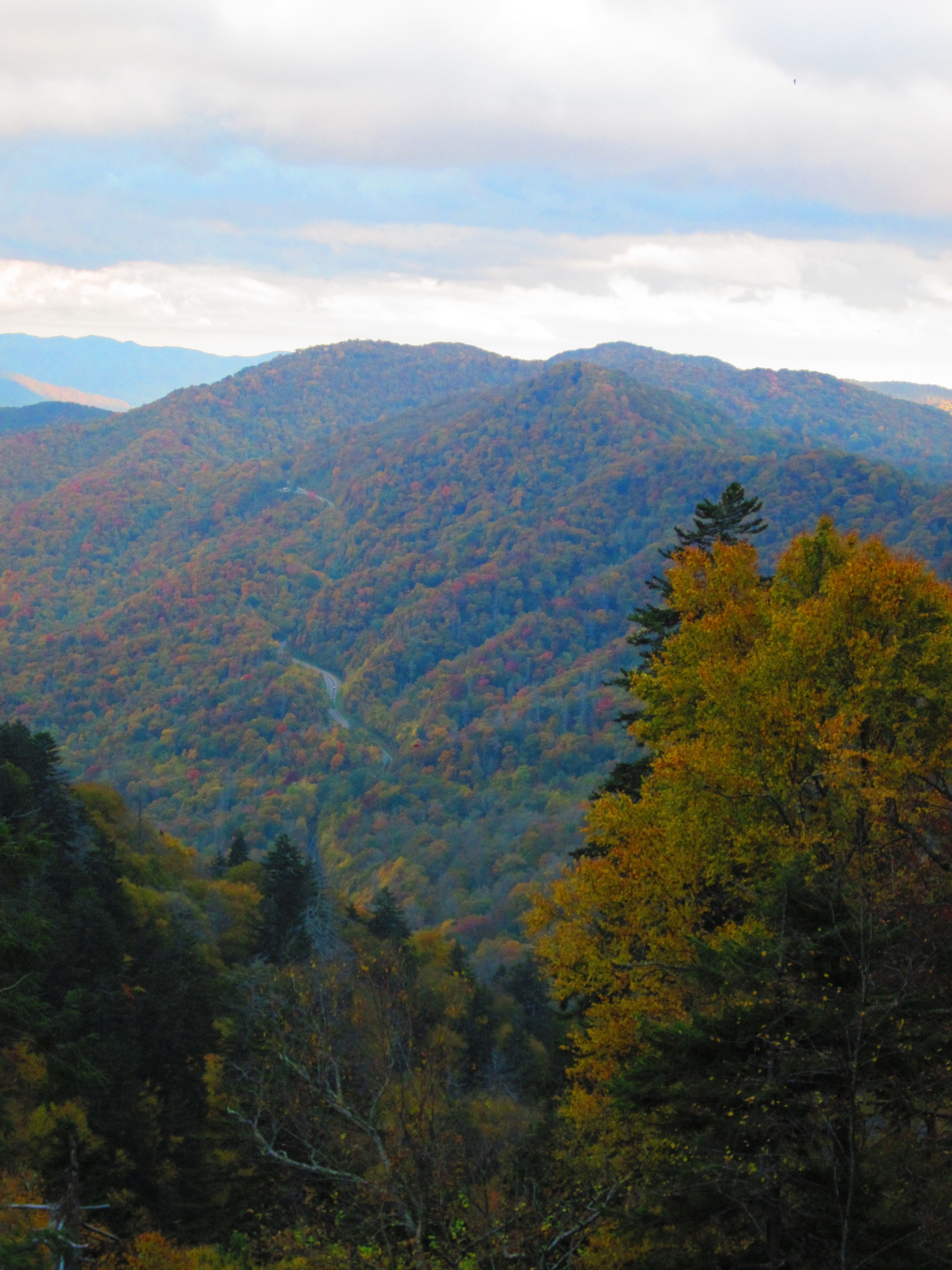
Native maples in their fall glory in GSMNP.
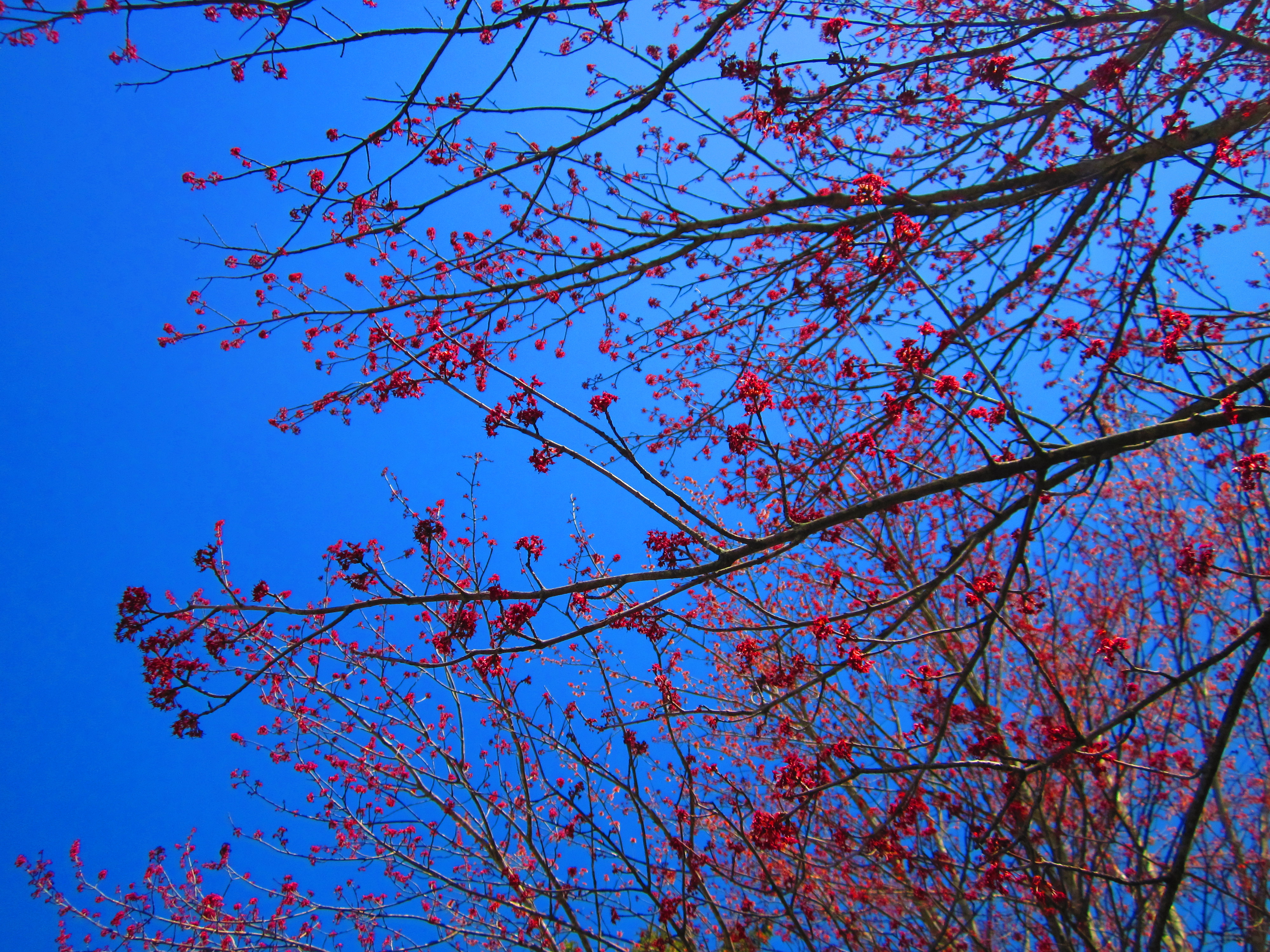
In addition to their fall foliage, maples should
be valued for their early spring blooms.

I love spring!  Signs of life, like buds forming on a tree or sprays of flowers pushing from the cold soil, make me think of the earth yawning, stretching, and rubbing the sleep from its eyes, ready to wake up for another season of growth.  One of my favorite signs of spring is when our native maples (Acer rubrum, A. saccharum, A. saccharinum) begin to bloom.

When many of us think of maples, our minds probably go straight to their spectacular fall foliage.  This is why most of the North American maples in the nursery industry are bred for their autumn color.  Their delicate spring blossoms are often overlooked, but en masse maples in flower can be real show stoppers.

My favorite way to view maples in their spring glory is by taking a long, Sunday drive on a back road.  Last weekend we drove down Route 441 from Townsend, Tennessee to Lake City, Florida.  The whole way down our native maples painted the roadside with sunny limes, yellows, peachy pinks, and bold scarlet reds.  Over the next month, whole mountain sides in the Great Smoky Mountains National Park will be dotted with the colors of maples in bloom. 

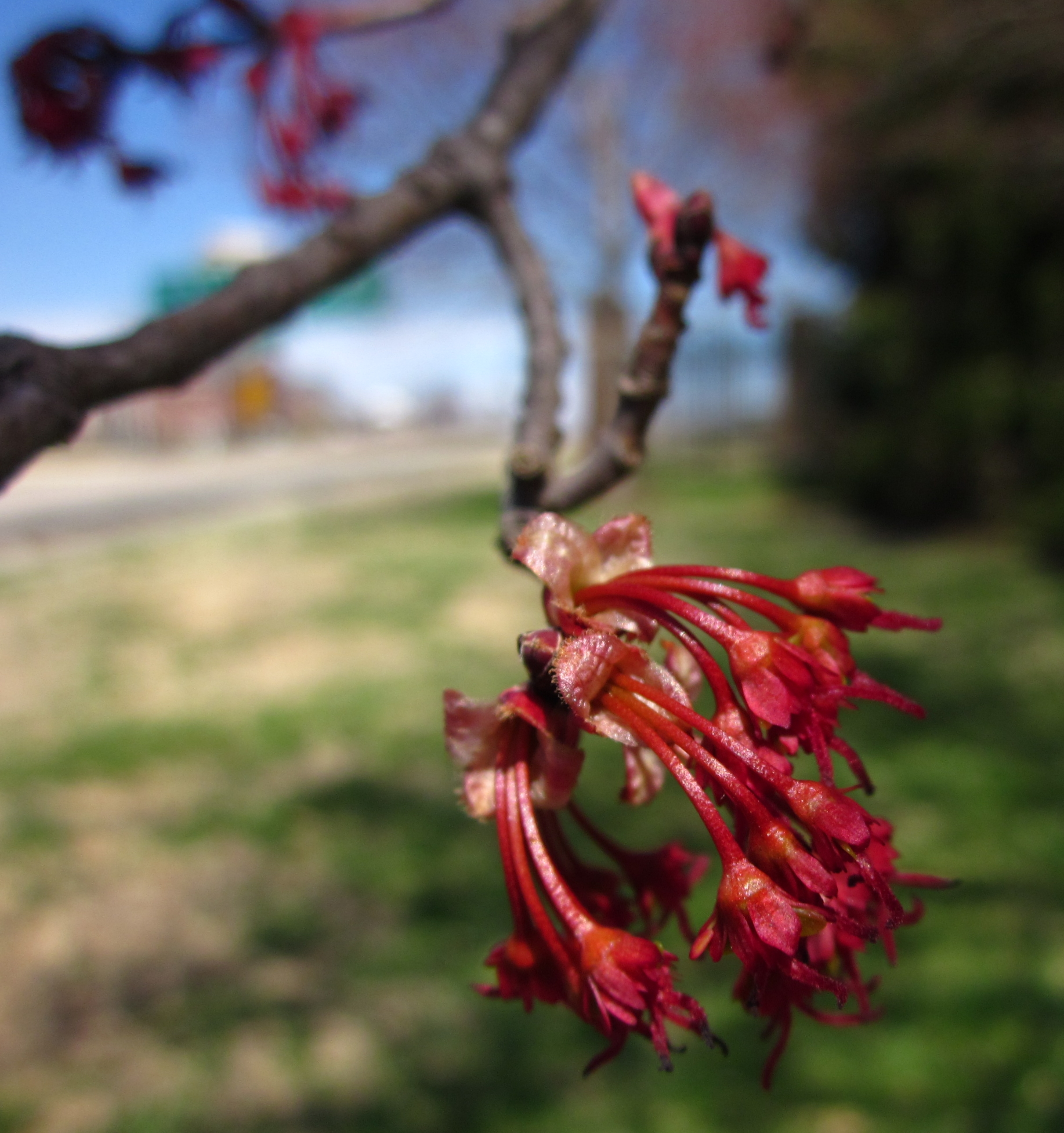
A cluster of maple inflorescences
Some specimens produce bolder, showier blooms than others.  Maples can bloom as early as January or as late as April.  Flowering in maples is both a response to environmental conditions and a function of genetic predisposition.  Genetic variation is responsible for inconsistency in blooming, which causes stands of maples in the wild to produce a smattering of blooms throughout the spring.  Although nursery breeders seek to control the genetic qualities of the maples they produce, flower time and quality is often an afterthought.  This means that maple flowering in the landscape can be just as inconsistent between two plants as in the wild.

When in flower, our North American native
maples can be just as showy as many
of the more familiar spring blooming trees

Unlike other spring flowering trees that are pollinated by bees and other insects (such as cherries, dogwoods, and redbuds) maples are wind pollinated. The earlier maples are able to blossom, the fewer barriers there will be to pollination.  For example, if a maple flowers in January, none of the other trees or shrubs have leafed out yet, so the pollen can travel unhindered from one flower to another.  This can be a risky move, because a cold snap can damage flowers and samara development.  On the other hand, if a maple flowers in April there will be less danger of cold damage. However, many other trees in the landscape may already have foliage, preventing how effectively wind can carry the pollen between flowers. 

Those who want to enjoy the spring blossoms of maples in the comfort of their own landscape may be in for disappointment.  As stated earlier, the industry doesn't currently breed maples for flower quality.  Strong, handsome maples that provide beauty, shade, and vibrant fall color may also produce lackluster blooms.  However, there are a few things you can do to improve your odds of finding a maple that will add stunning spring blooms to your landscape:

  • Consider a red maple (Acer rubrum) - Red maples purchased from a reputable nursery don't just produce red fall foliage (although many may also have yellow, green, and orange fall color).  Red maples tend to also generate scarlet inflorescences.  To quote Dr. Michael Dirr in his Manual of Woody Landscape Plants (1998), A. rubrum's "red, rarely yellowish" spring blooms may be composed of mostly pistils, stamins, or they may be monoecous, but "all are showy".
  • Buy local - This tip doesn't just mean you should support your local garden centers (which is always a good thing to do!).  Maples grown in your area are more likely to perform well in the long term and endure in the landscape than maples grown in another region of the country.  This is especially true for folks up north -- although maples grown in the south may be the same species as the maples native to your area, they typically aren't as cold hardy.
  • Avoid grafts? - If you're looking for a Japanese maple (A. palmatum), a graft is a must.  However, there are mixed reviews of how grafted red maples perform in the long run.  Dirr (1998) noted that grafted native maples tend to not perform as well long-term as maples grown from cuttings, tissue culture, or seed.  Remember, seed-grown plants may last longer than a maple grown from a graft, but with the genetic variation of seed-grown plants you never know what you're going to get.  On the other hand, Matt Nichols of Mr. Maple has successfully grafted red maples and has grafted sugar maples.  It would be a good idea to do some investigating and buy from a quality nursery.

Thank you to Garden Talk on Knox Talk 94.3 FM for inviting me on to present their plant of the week this morning!  If you're wondering, the featured plant was Acer rubrum.  To read more of my favorite plants, be sure to follow me on Plante on Plants.  To tune in to more gab from the garden gurus, stream Garden Talk live online on the Knox Talk website.

If you have any questions, ideas or suggestions, please feel welcome to post a comment below or to send me an email.

What are some plants that shout SPRING to you?  What's your experience with our native maples?  What are some other overlooked spring bloomers?


The delicate flower buds of Acer rubrum
Acer rubrum in bloom
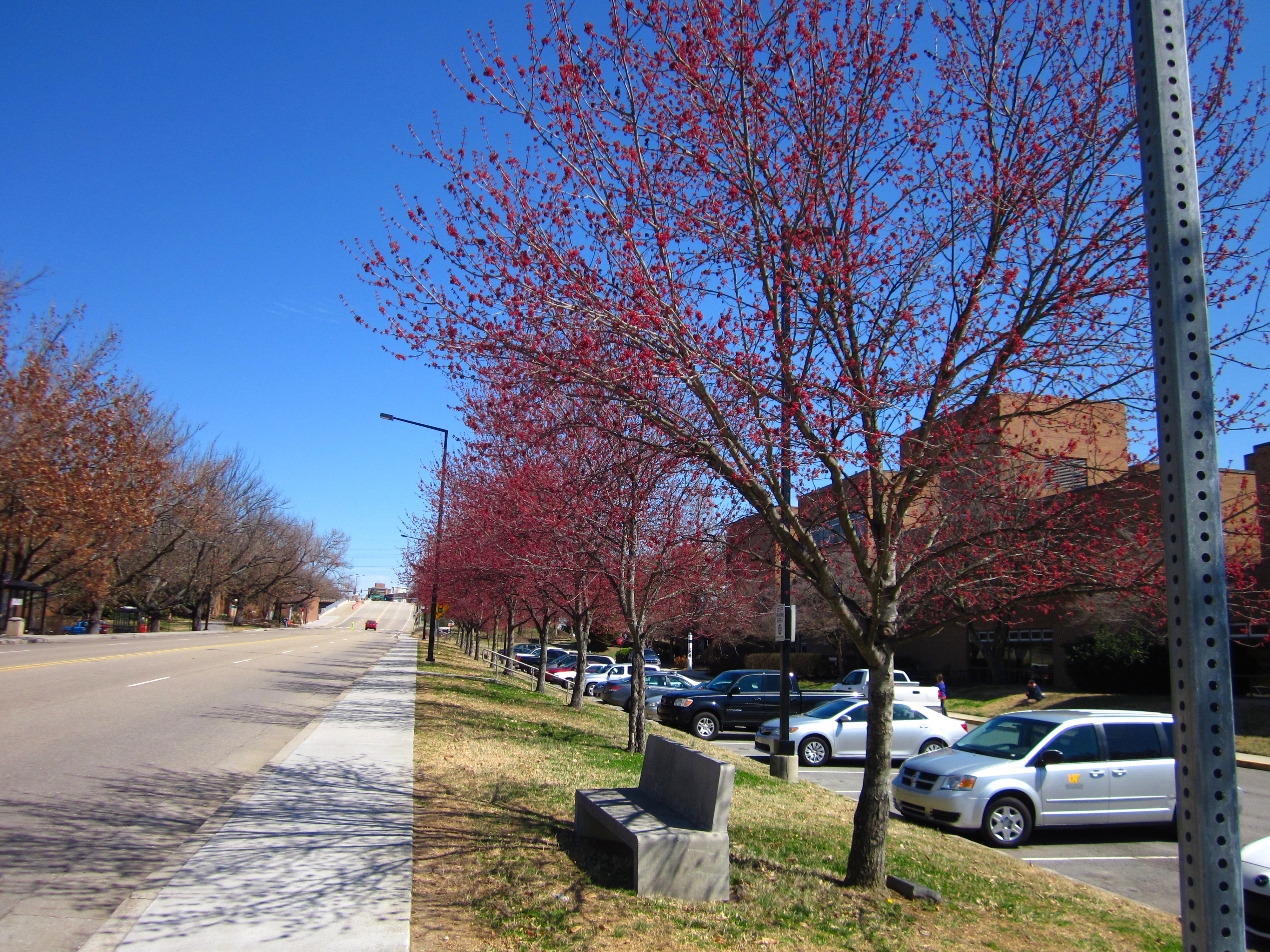
A hybrid maple, Acer x freemanii, makes an attractive street tree on the University of Tennessee's Agriculture campus.

Monday, December 3, 2012

Gardeners fight the winter blues with fiery red twig dogwoods

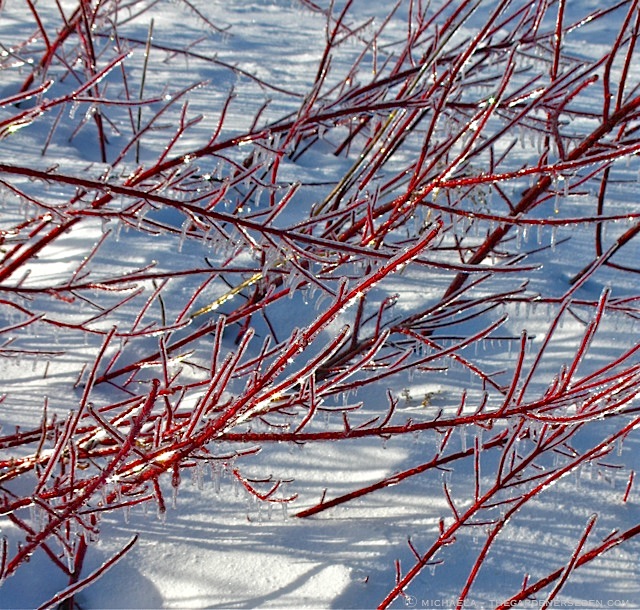
Red twig dogwoods add a splash of
color to the winter landscape
Winter is the season when the garden sleeps. Green turns to brown and flowers fade. Embracing the season of dormancy doesn't have to mean acceptance of a dreary landscape. Add a splash of color to the winter garden with red and yellow twig dogwoods that are most exciting in dormancy.

Strategically placed, colorful twig dogwoods help break the monotony of evergreen foundation plantings.  Although twig dogwoods are attractive as a specimen plant, they really make a statement en masse.  Plant at the border to create a river of color as a winter hedge.

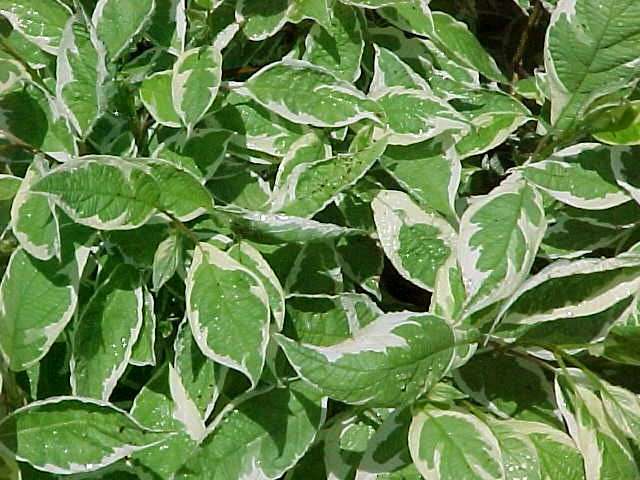
Of all the interesting new varieties out there, my favorite is Cornus alba 'Ivory Halo' (zones 3-7).  While other twig dogwoods tend to be a blob of green during the growing season, variegated foliage makes 'Ivory Halo' an attractive planting for any time of year.

Young dormant stems of 'Ivory Halo' are a fiery red that are an excellent source of winter interest.  For the best stem color, prune out old growth every spring or cut back hard the whole plant every few years.
Variegated foliage makes 'Ivory Halo'
dogwood attractive at any time of year.

Plant dogwoods in the winter when the plant is dormant.  Although dogwoods won't be actively growing leaves and stems in the winter months, roots will anchor into the soil and give the plant a head start on growth in the spring.

Available from many garden centers, a red or yellow twig dogwood will make the perfect holiday gift for any garden enthusiast.

If you have any questions, ideas, or suggestions, leave a comment or shoot me an email.

What's your favorite way to use red or yellow twig dogwoods?  What plants are your favorites for fighting the winter blues?


Fiery stems of red twig dogwoods contrast with white bark of paper birches (Betula papyrifera)
Yellow twig dogwood at the University of Tennessee Gardens.


Photos courtesy of: