Showing posts with label plante. Show all posts

Sunday, July 6, 2014

Add Impact (Literally) to Your Garden with the Exploding Cucumber, Ecballium elaterium

Echballium elaterium is in the
cucumber family, so it's not surprising
that the fruits look like little cukes
One this week's tasks at Kew was to prop up and cut back plants that were flopping into the grass paths of the Order Beds.  We were working under the guidance of Chrissy, one of Kew's horticulture students.  We walked through some of the lower beds, and she identified sections that needed to be propped and other plants that needed to be trimmed.  She warned me, "Watch out for the squirting cucumber."

Having just learned that one of the plants in the Cucurbitaceae beds squirted, and knowing full well what a cucumber looks like, I set off to work.  But by the time I had made my way down toward the end of the section, about twenty or so minutes later, I had already forgotten Chrissy's warning.  With the first snip of my secateurs (pruners), a small cucumber shot out from the foliage it had been hiding under and hit me square in the stomach.  Startled, I dropped my pruners and fell backwards, off of my knees and flat onto my rear.  I thought, "That's a plant worth writing about."

Mediterranean Roots
The exploding cucumber, also known as Ecballium elaterium (1790-624, UCNW), is native to the Mediterranean region.  As is true with many Mediterranean natives, this plant prefers well drained (but not dry) soil in a sunny location.  However, E. elaterium is adaptable and can handle less than ideal conditions.  Although this plant is a perennial in its native region, it is grown as an annual in cooler climates like England and much of North America (USDA hardiness zones 8b to 10a).

Flower bud, opening bloom, and
finished flower head of E. elaterium
The E. elaterium has been used medicinally since the time of the ancient Greeks.  One of the first written records of this plant is by Hippocrates (460 - 375 BC), who described how to prepare various parts of the plants to cause purging in patients.  The specific epithet elaterium is actually derived from the Greek "elaterio" which means "to cast out".  This probably has more to do with the fact that the plant shoot its seeds out up to 6 feet (see video below) rather than its medicinal use for purging and reducing fluid retention.

There is no indication that this plant is in danger of extinction in its natural habitat today, either from the CITES database or the IUCN Red List of threatened species.

Botanical Description
E. elaterium was first described in 1824 by Achille Richard, French botanist, doctor, and director of the Benjamin Delessert Herbarium and at Paris' Muséum d'Histoire Naturelle.  Several online sources state that the plant is so toxic that a doctor suffered "serious symptoms" when transporting seeds of this plant inside of his hat, from the Jardins de Plantes to his home in Paris.  Perhaps that doctor was Achille Richard?

Anatomical Characteristics
E. elaterium has the same growth habit as a bush cucumber, although the vine does not produce tendrils.  The leaves, flowers, and fruits (to an extent) also look like those of a cucumber.  However, this plant should not be eaten like a cucumber, because it is poisonous.

The exploding cucumber makes a
nice, silvery groundcover that provides
a literal impact factor to any landscape
Although the fruits looks somewhat like little cucumbers, they are much smaller (about 2 inches in length) and contain fluid and seeds.  As the fruits develop, they become slightly pinched on one side, which increases the pressure inside.  When the stem and fruits begin to yellow, a small brush from an unwary animal or gardener will cause the fruit to shoot off of its stem, spraying fluid and seeds behind it.  If any seeds get stuck to the unfortunate (and probably very startled) soul that disturbed the plant in the first place, they may transport the plant's genetic material to a new place, where the exploding cucumber can start this process all over again.

Landscape Value
The exploding cucumber has really nice silvery, densely pubescent foliage and stems.  This ground cover would be good when contrasted with plants that have different forms and textures.  Perhaps in a large container with a bold, upright 'Sparkling Burgundy' pineapple lily (Eucomis comosa) and a fine, feathery 'Rita's Gold' Boston fern (Nephrolepsis exaltata).  E. elatarium should grow to drape over the edge of the container, showcasing its beautiful foliage and explosive fruits.

This plant has a lot of impact factor -- literally.  This would be a fun addition for a home landscape near walkways to startle unwitting guests.  However, use with care.  This plant is toxic.  So although it seems like the perfect, fun addition to a children's garden, it really should not be grown in that situation.  Children may confuse the fruits with actual cucumbers, eat them, and become very sick.

So if you're looking for a fun, adaptable annual to try in your garden this year, consider adding the exploding cucumber.  Remember to plant responsibly -- this plant shouldn't be grown where children can get a hold of the fruits and eat them, because they could become very sick.

If you have any questions, comments or suggestions, please feel welcome to leave a comment or send me an email.

To see more photos from this week, be sure to check out the album "Exploding Cucumber" on the Plante on Plants Facebook page.  "Likes", shares and comments are appreciated.


All photos and videos were taken by Amanda Plante at the Royal Botanic Gardens, Kew unless otherwise stated in the caption.

Sources:

Sunday, June 29, 2014

Giants in the Conservatories, Victoria amazonica and cruziana

Introductory page to Twelve Views of
Guiana
.  Note the V. amazonica in the
water. (Schomburgk, 1841)
Several years ago when I was just getting started in horticulture, I was flipping through a textbook and saw an old photo of a child standing on a massive lily pad.  The caption read something like, "Child supported by foliage of Victoria amazonica".  I thought to myself, "I'd like to see that."  And this week I finally did.

Kew currently cultivates two species of giant waterlily, both of which are in the waterlily family Nymphaceae.  Victoria amazonica (2007-1804, KKNO), formerly V. regia, grows in the Princess of Wales Conservatory and V. cruziana (2011-1436, HSIK) in the Waterlily House.

Discovery and Present Range

According to Ray Desmond in The History of the Royal Botanic Gardens Kew, V. amazonica was first seen by a European, a botanist for the Spanish government, in 1801 in Peru. Subsequently, botanists from France spotted the species in Argentina in 1828, a Germany botanist found it in the Amazon in 1832, and Robert Schomburgk found it on the River Berbice in British Guiana in 1837.  Schomburgk shared parts of the plant that he collected and drawings with John Lindley (who had an influential role in keeping Kew intact during a turbulent period in its history).  Lindley named the plant Victoria reggia after Queen Victoria (Desmond, p. 178).

Tom and Tiffany prune and remove flower buds from
V. amazonica in the Princess of Wales Conservatory

V. cruziana inhabits a similar region, with a range from Paraguay to Northwest Argentina.  Both of these massive waterlilies can be found today in South America near Bolivia.  Neither of these species have been assessed by the IUCN for any threats to their existence in the wild.  Furthermore, CITES did not list either Victoria in their endangered species database.  Although those organizations have not listed these as threatened species, the environment they are native to could be damaged by climate change and human development.

Cultivation at Kew

Victoria amazonica was first cultivated at Kew in 1846, when twenty five seeds were bought from a collector from Bolivia.  Only two of the seeds sprouted, but they died shortly afterwards.  The issue seemed to be how the seeds were transported from Bolivia to England.  The first shipment had been packed it clay, and the next two were packed in soil in a Wardian case, dry capsules.  A fourth shipment of seeds packed in clean river water that arrived in 1849 was more successful.  That season Kew was able to raise 50 plants in a large tank in one of the glasshouses.

Visitors from around the globe stop in the
Waterlily House to inspect V. cruziana
At that time, several gardens in the area were essentially competing to see who could coax the first flower.  While the specimens at Chatsworth and Syon house were blooming, Kew's attempts were unsuccessful, possibly due to the poor quality of the Thames River water.  The first Victoria amazonica bloomed at Kew in June 1850.

The popularity of the giant water lily inspired Kew's director at the time, William Hooker, to commission a new building to house and display these finicky plants.  They completed the structure, today known as the Waterlily House, in 1852.  However, V. amazonica did not thrive, and was moved to another house (Desmond, p. 179).  Today you can find V. cruziana growing there in its place (Desmond, p. 313).

It is interesting to note that the V. cruziana growing at Kew wasn't the original collection.  Kew lost all specimens of this plant during World War II.  At that time, the conservatory at the University of Helsinki was damaged during a bombing.  Helsinki's V. cruziana survived the attack, and the progeny were sent to Kew, where they have been cultivated in the Waterlily House since 1999 (Desmond, p. 358)
Characteristics

Foliage
As is true of many plants, the foliage of Victoria unrolls as it opens.  The underside of both V. amazonica and V. cruziana is covered in sharp spines.  The prickly spines beneath the opening leaves gives a strange, otherworldly appearance to the new growth.  These spines help prevent the leaves from being eaten by hungry fish, which would negatively effect how the foliage functions.

Unfurling new growth of V. amazonica
You see, in addition to spines, there are also deep ribs underneath the massive lily pads.  These ribs hold air beneath the pad to keep it buoyant.  They also provide structural support, like the frame of a house.  Enough strength, at times, to support the weight of a small human.  So if a grazing fish were to nibble too much of the foliage, this would compromise the strength of the leaf and its ability to stay afloat.

Another interesting fact about Victoria leaves is that the foliage will grow to the size of the container.  When I asked Silke, who works in the Waterlily house about the feasibility for growing V. cruziana at home, she concluded that it would be possible, but difficult.  And if placed in the size pond that is regularly found in a home landscape, the foliage wouldn't be much larger than that of any other lily pad.

Differences
Although the leaves of V. cruziana
(above) are smaller than V. amazonica,
it has a much taller lip.
So what's the difference between the foliage of these two giants?  For one thing, V. amazonica tends to produce larger leaves.  The foliage of V. amazonica can reach 2.5 meters in diameter, while the diameter of V. cruziana's leaves usually maxes out closer to 2 meters.  But these statistics don't stop a little friendly competition between staff in the Waterlily House and the Princess of Wales Conservatory. 

This year, the staff competed to see who could produce the largest lily pad by a certain date. Silke in the Waterlily house told me that her group had lost the competition because they got a later start.  I asked Tom, an apprentice, and Tiffany, a staff member, in the Princess of Wales Conservatory about the wager.  Tom grinned and said, "Yeah, it wasn't even close."

Although the foliage of V. amazonica may grow larger than V. cruziana, the edge of the pad is not as tall.  While this may not seem that important at first, a tall edge is crucial to prevent other leaves that would compete for sunlight from sliding on top of the pad.  This lip can also be more aesthetically appealing.  It provides more of a reflection on the water, and is really lovely when the sunlight shines through.

Flower
Unopened V. amazonica flower bud, held by Tom, an
apprentice in Kew's Princess of Wales Conservatory
Both species have large, creamy white flowers that open in the evening and are pollinated by beetles. Even though both giant waterlilies are starting to set flower buds at Kew, you won't see any on display until later in the year.  When I arrived at the Princess of Wales Conservatory, Tiffany and Tom were pruning out the prickly buds to compost.  The reason why is that if allowed to flower, the plants' energy would go into flowering, fruiting, and setting seed rather than growing large leaves.  People come to Kew from all around the world to see these massive lily pads, so Kew does their best to produce big ones.

However, the species in cultivation at Kew are allowed to flower later in the year, because the seed is vital to producing the next season's crop.  Neither V. amazonica or V. cruziana will reliably overwinter at Kew, even if provided the best possible environment.  So, staff pollinate the flowers by hand, store the seeds in water, and start new seedlings early in the year and grow them on in the Tropical Nursery glasshouse so when they are ready to move they are large and ready for visitors.

Cultivation

Tom disects the unopened flower bud
of V. amazonica so we can inspect
the anatomical features
Although both species of Victoria thrive at Kew during the warmer months, both begin to decline in the fall.  This makes sense, because both plants are native to the tropics of South America.  For interested readers in the US, their USDA Hardiness Zones are 10-11.  For readers in the UK and beyond, that means they can tolerate a minimum temperature somewhere between 4 and 11 degrees Celsius.  Measures could be taken to overwinter the plants, but the effort would require very specialized environments with specific heat, supplemental light, and water requirements.  Instead, Kew treats these plants as annuals rather than temperennials.

In Kew's online profile of V. amazonica, they note that aphids can be a problem at times.  They try to reduce pest and disease pressures by keeping the plants healthy and happy by adding plenty of fertilizer, growing in a large enough pot, and regular pruning.

A Sight Worth Seeing

Before leaving the Princess of Wales Conservatory, I took a moment to stand back and take in one last look of those giant leaves.  An older gentleman had pushed his father in a wheelchair to the water's edge while I'd been speaking to Tiffany and Tom.  "What do you think of it?" I asked.  "I've never seen anything like it," the father responded. "Neither have I."
If you have any questions, comments or suggestions, please feel welcome to leave a comment or send me an email.

Victoria amazonica can be seen in Kew's Princess of Wales Conservatory
Kew's Victoria cruziana is on display in the Waterlily House
All photos were taken by Amanda Plante at the Royal Botanic Gardens, Kew unless otherwise stated in the caption.

Sources:
  • Center for the International Trade in Endangered Species database
  • Desmond, Ray.  (2007).  The History of the Royal Botanic Gardens Kew (2nd Edition).  London: Kew Publishing, Royal Botanic Gardens, Kew.  177-179, 345-346.
  • Kew's Living Collections database
  • Missouri Botanic Gardens plant finder database
  • Perennial Resource glossary
  • The International Union for Conservation of Nature and Natural Resources Red List of threatened species
  • The Plant List website
  • The Royal Botanic Gardens, Kew website and staff
  • Schomburgk, Robert H. (1841).  Twelve views in the interior of Guiana from drawings executed by Mr. Charles Bentley, after sketches taken during the expedition carrier on in the years 1835 to 1839, under the direction of the Royal Geographical Society of London, and aided by Her Majesty's government with descriptive letter-press.  Retrieved from The New York Botanical Garden Mertz Digital Collections.

Monday, March 18, 2013

Quick and Dirty Tips for Tree Planting

I apologize for falling behind on blogging.  School this semester has not left a lot of free time for writing, but I do want to continue with regular posts.  So, in the spirit of brevity, please enjoy the following quick and dirty tips for planting trees.  Stay tuned for the quick and dirty tips for pruning.

Timing is Everything
Cool winter months is a great time to plant dormant trees and shrubs.  Without the burden of green foliage that requires a constant flow of water, woody specimens are able to develop a healthy root system.  The earlier in the winter that you plant your trees, the more time their roots have to develop, and the better prepared the trees are to withstand summer heat.  In Knoxville, March is about the latest that I would recommend planting trees and shrubs.

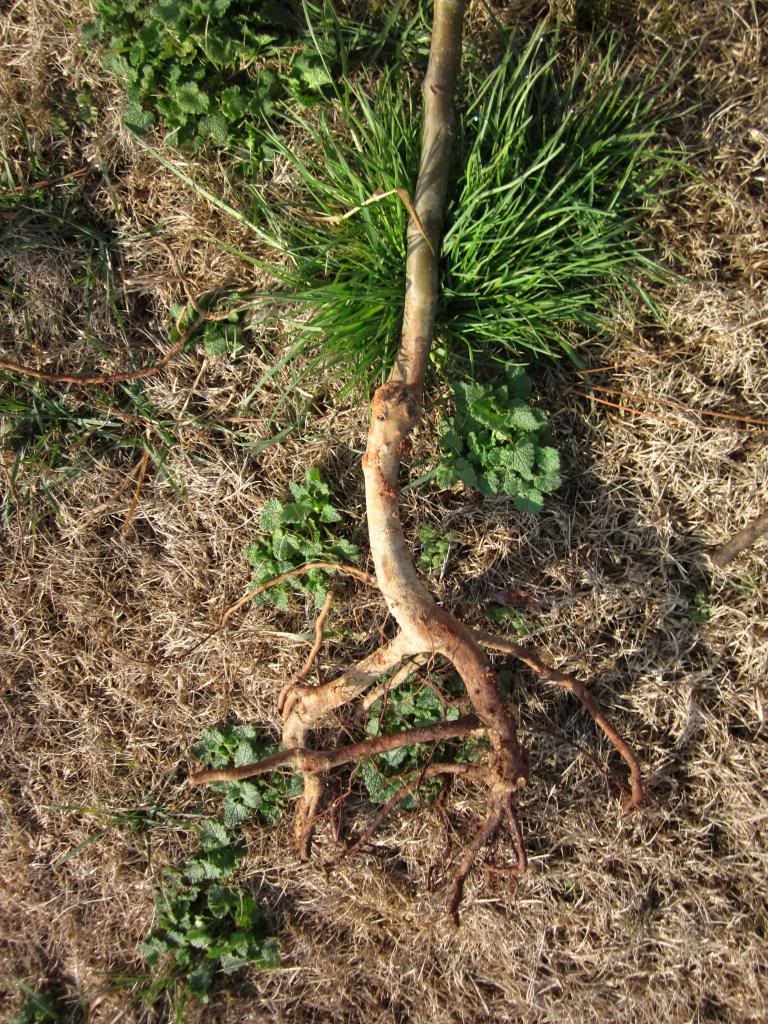
A "bare root" tree is exactly what it sounds
like -- there is not soil around the roots.
Container or Bare-Root?
Many homeowners buy trees and shrubs grown in containers from a nursery or box store.  While I am all for supporting your local nursery, I prefer to plant "bare root" woody specimens.  Bare root plants are exactly what they sound like -- there is no soil around their roots.  In my experience, bare root trees and shrubs are less expensive, establish faster and perform better than container grown plants.  Bare root specimens can be ordered through the internet or catalogue from a reputable source.  Ball and burlap is another option as well.

Eliminate the Competition
Although most weeds in and of themselves may not be a threat to successful growth of trees and shrubs, their presence near the trunk is undesirable for a couple reasons.  Aesthetically, you may not want weeds cluttering up the "drip zone," or area beneath the foliage of your tree.  If the tree is to be planted in an area that is mowed regularly -- like the front yard -- if there are weeds and grass growing near the trunk you may risk having your tree damaged by a weed eater or lawn mower.  For these reasons, it is a good idea to use your shovel to remove existing weeds and grass from the area around your tree prior to planting.

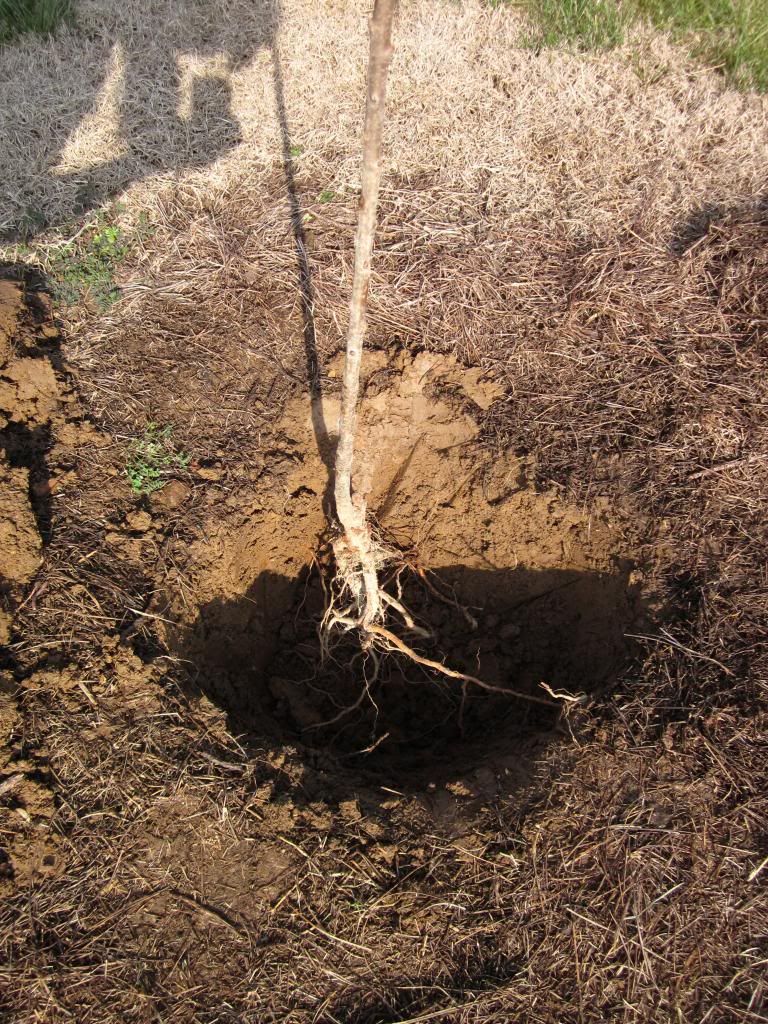
Make sure your hole is at least big enough
to hold all of the plant's roots.
Dig Baby, Dig
If your tree is a container tree, make sure your hole is at least bigger than the plant's container.  Some people suggest digging a hole that is twice as wide.  I haven't noticed much of a short or long term difference between the growth of trees that were planted in sufficient size and larger holes.  If you are planting a bare root tree or shrub, make sure the hole is large enough to sufficiently hold all the roots.

To Amend or Not to Amend
Some people amend the soil in the hole with potting soil, good topsoil, sand, compost, or fertilizer.  I like to think of it this way -- in a year, your tree's roots are going to expand far beyond that zone.  Why put off the inevitable?  In some cases, amending the soil can actually hurt the tree's development.  For example, if a heavy clay soil is amended for a tree, the slow draining clay can create a basin that holds water around the tree's roots and causes them to rot.  However, if you are growing a tree or shrub that has a specific soil pH (acidity or alkalinity) requirement, the soil will need to be amended with sulfur to lower pH and make more acidic or lime to raise pH and make more alkaline in order for the tree to grow properly.

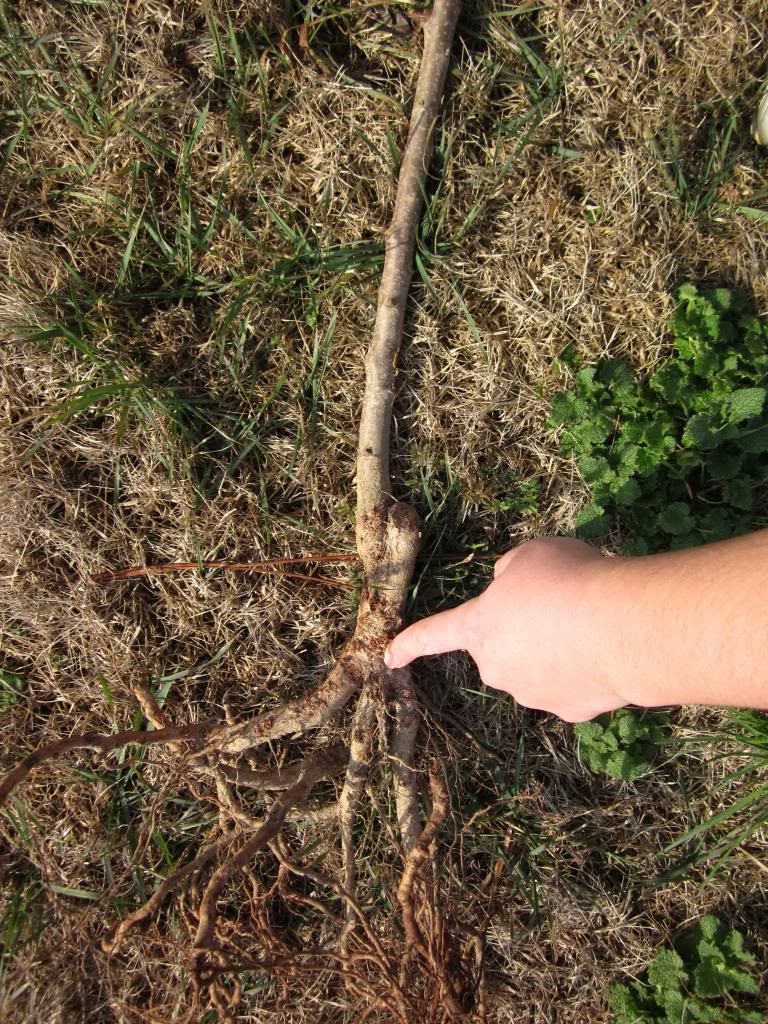
Look for the "root / shoot" junction before
planting your tree.
Look for the Root-Shoot Junction
There have been times when I've planted a tree and a year later it dies inexplicably.  My sleuthing did not turn up any fatal pest or disease problems.  The cause of the tree death was actually being planted too low or too high.  Now when I plant trees, I keep my eyes peeled for something called the "root / shoot junction."  Look on the trunk of your tree for the spot where the roots become the roots and the shoot becomes the shoot.  When you plant your tree, make sure the roots are below ground and the trunk is above ground.  Most of the time, the soil line of container grown trees is already at the root / shoot junction, but double check to be sure.

Add Mulch
Mulch is important for weed suppression, protecting the trees from lawn mower or weed eater damage, and just plain old looks pretty.  For new beds, add about 3 inches of mulch under the drip zone of the tree.  After mulching, be sure to pull the mulch away from the trunk of the tree.  Be sure to avoid the "mulch volcano" look -- that is not attractive and it is unhealthy for your tree.

Thanks for reading and stay tuned for the quick and dirty tips for pruning, hopefully coming up soon!

If you have any questions, ideas, or comments, please don't hesitate to leave a comment or send me an email.

To see more of my tree maintenance pictures, check out my photobucket story.

Do you prefer container trees or bare-root?  What tips and tricks have made your trees and shrubs grow successfully?


The Knoxville Botanical Garden and Arboretum's "Every Child Outdoors" Fruit Grove

Wednesday, January 2, 2013

Pony tail palm, a living statute that adds interest to any residence

A large Beaucarnea trunk surrounded by tropical foliage
at Nashville's Opryland Atrium, 2010
When the garden slows down in the winter, many gardeners turn their attention to their houseplants.  If you're anything like I am, caring for a green, living houseplant is like a form of gardening life support -- it keeps me focused through the winter.

One of my favorite interior plants is Beaucarnea recurvata, more commonly known as pony tail palm or elephant-foot tree.  The pony tail palm can develop lovely curly foliage that cascades over the edge of whatever piece of furniture it's sitting on.  The trunk has a nice gray bark, and the base of the plant will swell creating a bottle-neck appearance.

Pony tail palms are extremely slow growing, but given time a tree can reach 30 feet in height.  Beaucarnea recurvata prefers a high light situation when
I strike a pose with a large pony tail palm in
 Nashville's Opryland Atrium, 2010.
grown indoors, and will grow best by a sunny window.  Native to the deserts of the North American South and South West, pony tail palm does not require a lot of water.  The base of the plant actually serves as a water reservoir.  To prevent over-watering, I tend to wait until the base starts to get a puckered, wrinkly appearance instead of watering when the soil is dry.

Small specimens can be purchased from a local garden center, box store, florist, or grocery store.  Between the low maintenance requirements and statuesque form, pony tail palm is a great choice for any residence.

If you have any questions, ideas, or suggestions, leave a comment or shoot me an email.

How has pony tail palm grown for you?  What's your favorite interior plant?  How do you beat the winter blues?


My small pony tail palm serves as a living statute in my residence.

As seen from this specimen grown in Nashville's Opryland Atrium, pony tail palms can be multi-stemmed.

Monday, December 3, 2012

Gardeners fight the winter blues with fiery red twig dogwoods

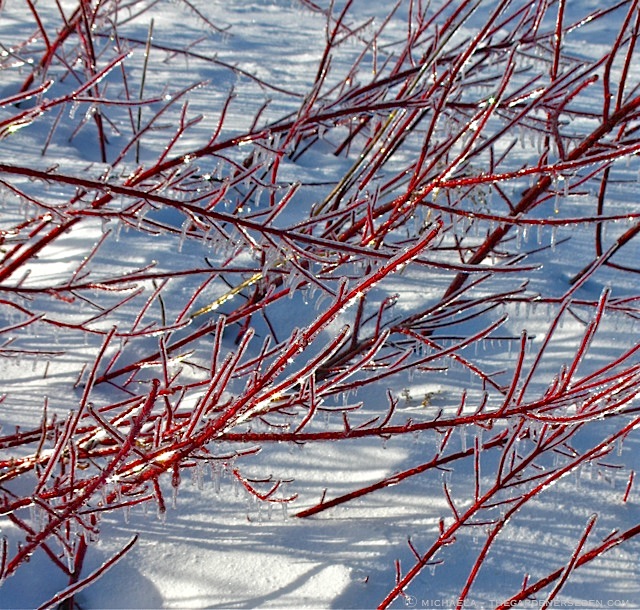
Red twig dogwoods add a splash of
color to the winter landscape
Winter is the season when the garden sleeps. Green turns to brown and flowers fade. Embracing the season of dormancy doesn't have to mean acceptance of a dreary landscape. Add a splash of color to the winter garden with red and yellow twig dogwoods that are most exciting in dormancy.

Strategically placed, colorful twig dogwoods help break the monotony of evergreen foundation plantings.  Although twig dogwoods are attractive as a specimen plant, they really make a statement en masse.  Plant at the border to create a river of color as a winter hedge.

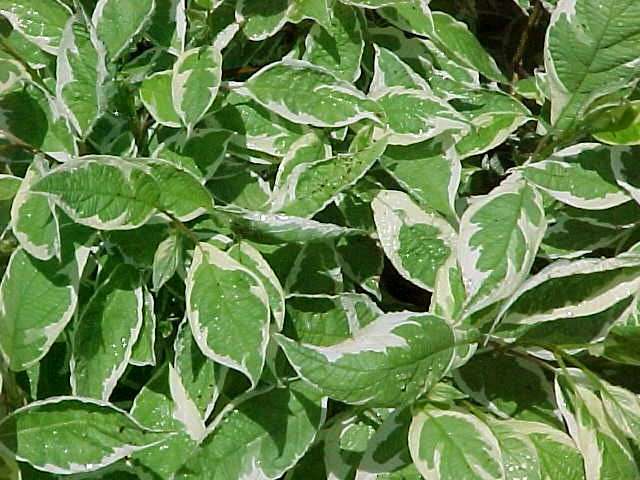
Of all the interesting new varieties out there, my favorite is Cornus alba 'Ivory Halo' (zones 3-7).  While other twig dogwoods tend to be a blob of green during the growing season, variegated foliage makes 'Ivory Halo' an attractive planting for any time of year.

Young dormant stems of 'Ivory Halo' are a fiery red that are an excellent source of winter interest.  For the best stem color, prune out old growth every spring or cut back hard the whole plant every few years.
Variegated foliage makes 'Ivory Halo'
dogwood attractive at any time of year.

Plant dogwoods in the winter when the plant is dormant.  Although dogwoods won't be actively growing leaves and stems in the winter months, roots will anchor into the soil and give the plant a head start on growth in the spring.

Available from many garden centers, a red or yellow twig dogwood will make the perfect holiday gift for any garden enthusiast.

If you have any questions, ideas, or suggestions, leave a comment or shoot me an email.

What's your favorite way to use red or yellow twig dogwoods?  What plants are your favorites for fighting the winter blues?


Fiery stems of red twig dogwoods contrast with white bark of paper birches (Betula papyrifera)
Yellow twig dogwood at the University of Tennessee Gardens.


Photos courtesy of:

Friday, October 31, 2008

Why I Would Never Plant A Hackberry Next to a Parking Lot

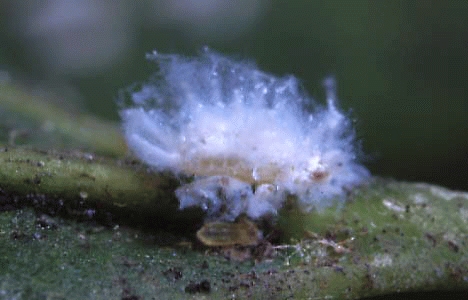
Wooly hackberry aphid, photo courtesy of ag.auburn.edu (mine didn't turn out)
Years ago, many of America's street trees were from the genus Ulmus.  With the rise of Ophiostome ulmi, or Dutch Elm Disease, many Elm street trees were in need of replacement.  Celtis occidentallis, better known as the Common Hackberry, seemed like the tree for the job.

Walking around the University of Tennessee campus in Knoxville, next to many roads, parking meters, and parking lots one will notice an abundance of these graceful trees.  They provide nice filtered shade and grow relatively well in their locations.  Hackberries also have an attractive (if sometimes gnarly) growth habit, interesting warty bark, delicate yellow fall foliage, and fruits that birds and other wildlife can't resist.

So what's the problem?

This summer, the Asian Wooly Hackberry Aphid hit our area, and our hackberries, hard.  A hackberry in the very back corner of my back yard was so eaten up by the wooly aphids that it looked like it was covered with snow.  Many a time this summer I would be working in the front yard when a breeze would come from that direction and the wooly aphids would blow all over the place (like pollen, an insane amount of dandelion seeds, or again, like snow).  They would blow on my clothes and in my hair.  And while that is annoying, that's not the worst part.

Many may know that aphids excrete a substance called "honeydew".  Ants love this sticky substance because it is sweet.  When the wooly aphids are on a hackberry, they drop their honeydew all over anything below the tree.  One hackberry provides shade for a picnic area next the the UT Gardens, behind the vet clinic.  This summer, that area was glossy and even kind of sticky from the excretion.

Many cars parked under hackberries on the street will also become glossy and sticky from the honeydew.  Before a road trip, I noticed a friend's car had this honeydew on it.  He wanted to leave it because he likened it to a "cool paint job".  Remembering that a coworker informed me that honeydew will turn into a black mold, I strongly suggested he wash his car at the first gas station we come to.  As soon as the soapy water touched the car, a terrible smell enveloped the area that took more than half an hour of driving with the windows down to get rid of.

Don't get me wrong.  Hackberries are beautiful, soft, graceful trees.  They have great landscape value and their warty bark provides really great winter interest.  These trees would make a great addition for most landscape uses -- but not as a street tree where, if it gets hit with the Asian Wooly Hackberry Aphid, the cars below will need to be washed regularly.

Friday, October 3, 2008

Verbena 'Homestead Purple'

Butterflies, like this swallowtail,
absolutely love 'Homestead Purple' verbena
Verbena canadensis, also known as "Clump Verbena", is valued for its color, habit, and durability. Round clusters of flowers on all clumping verbenas generally last from summer until fall, contrasting the almost spherical flower-shape with the very prostrate habit of the plant itself. Reaching 9" in height at the most, this plant can be a vigorous spreader. In fact, Clump Verbena propagates itself easily by air-layering. That is, its stems grow so low to the ground, that given the right conditions the stems will start to grow new roots and spread even farther as a new plant. This plant does best in a well-drained soil and a full-sun site, but keep in mind that when this plant is happy, it can become incredibly difficult to manage because it will spread so vigorously. If planted in perhaps partial-sun, the plant should live but be less vigorous and produce fewer flowers. Also, if planted in soil that does not drain well, Clump Verbena becomes susceptible to powdery mildew. Be aware of what hardiness zone you are in when planting Clump Verbena, because it is only hardy as a perennial in zones 6 - 10. If planted any farther north from our East Tennessee location, Clump Verbena is considered an annual.

The story of Verbena canadensis 'Homestead Purple' is one worth mentioning. It begins when two horticulturalists from the University of Georgia by the names of Allan Armitage and Michael Dirr (sound familiar?  You may see these names on your book shelf) were driving back to their university from Atlanta, GA. At one point, a brilliant purple in a yard they were passing happened to catch their eyes. They went to investigate what particular variety it was, but the homeowner only knew that it had always been growing in her yard. She gave them some cuttings which were later named 'Homestead Purple'. Today it is believed that 'Homestead Purple' is a cross between the traditional Verbena canadensis and some unknown variety that may not even exist anymore.

The cultivar of Verbena canadensis 'Homestead Purple' is valued in today's market for its low spreading habit, rich purple flowers, and spring / early summer blooms that will last until frost. This specific cultivar is located in at least three areas of the University of Tennessee Gardens. Not only is 'Homestead Purple' valued for its long bloom period, but the coarse texture of its evergreen foliage can definitely add winter interest to your perennial garden. Also, if you want to attract wildlife such as butterflies, this plant is an excellent selection. One suggestion for 'Homestead Purple' is that it should be planted near taller, more shrubby plants. This way, if it grows vigorously, it will not suffocate other smaller plants and you won't have to worry about cutting it back so often.

Update (2013): 'Homestead Purple' is easily propagated by rooting cuttings, division, or just pulling up stem sections that have rooted by layering.  March of last year we planted 3 very small rooted cuttings of 'Homestead Purple' around the Knoxville Botanical Garden & Arboretum's new "Every Child Outdoors" Youth Vegetable Garden.  Each plant was just around 3 inches tall.  By May, each plant was so large many visitors believed the Verbana that were spilling out of the beds must have been there for years (We had only just built the garden!).

'Homestead Purple' is an impressive, reliable perennial that can't be beat in a "transition zone" garden.


Sources
North Creek Nurseries
Stills, Steven M. Manual of Herbaceous Ornamental Plants.

Photo from: http://www.allanarmitage.net/about_dr_armitage